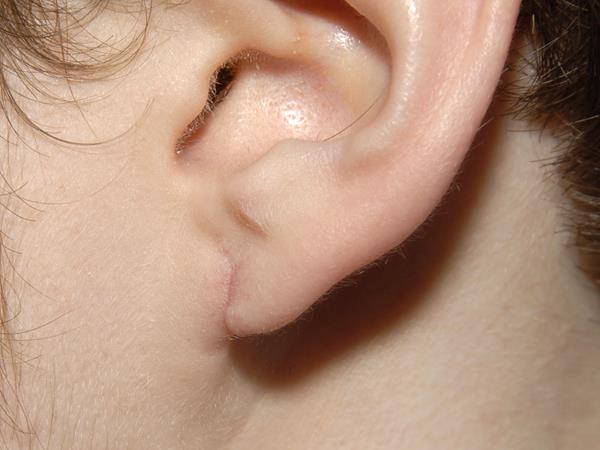

Split ear lobes are a common problem. This is where an earring pulls through the earlobe leaving a split behind.
Ear lobes are frequently damaged by earrings. The piercing hole may be enlarged so it no longer holds the earing, or it may cut out completely to leave a cleft in the earlobe.
These can be repaired as an outpatient under local anaesthetic (injection to numb the skin). Stitches may be dissolvable or need to be removed.
Earlobe repair is usually successful. It does leave a scar which is visible on the earlobe. Scars vary from one person to another. If you get your earlobes re-pierced through the same hole it is likely to cut out again. If you have your earlobes re-pierced it is important that it is through non scarred ear lobe not through the repair.
More extensive earlobe repairs, such as from flesh tunnels, are covered the flesh tunnel page.
There are a number of ways to repair a split ear lobe. The simplest is to remove the skin on the inside of the split and then stitch the ear back together. This usually achieves the desired result. It does leave a scar. You should not re-pierce the ear at the same place because scar tissue does not support an earring and it will cut out again. You can have the ear re-pierced once the ear is fully healed but it must be through fresh tissue.
All surgery has risks. The main risks with a split ear lobe repair in the early stages would be bleeding and infection. Once healed there is a small risk of keloid scar formation. Keloid scarring is where the scar tissue builds up into a lump. These can be troublesome and difficult to treat.
I usually recommend surgically removing the split and then suturing (stitching) it closed. This is the simplest approach and usually works well. There are a number of complicated ways of repairing earlobes. These use interdigitating flaps to leave a zigzag scar. They aim to make the scar less obvious and avoid a slight notch on the margin of the earlobe. In practice I consider them unnecessary and if you make poor scars the end result can be considerably worse.
The time it takes to repair an earlobe varies with how complicated the repair needs to be. It generally will take between 10 and 30 minutes.
A repair of a single simple split earlobe will usually replace the split with a narrow scar of a similar length to the original split. There may be a slight depression along the line of the scar. On the margin of the earlobe there may be a slight notch where the scar pulls in.
A split earlobe repair does require stitches. These are usually dissolvable and do not need to be removed.
The ear lobes can be re-pierced but this should not be through the scar tissue of the repair. If they are re-pierced through the repair the earrings will usually cut out again leaving you with a split earlobe.
The area around the split earlobe is numbed with an injection of local anaesthetic. Local anaesthetic injections sting and are uncomfortable. Once the local takes effect usually with a couple of minutes the area becomes numb and you will feel no pain. You may be aware of pulling and tugging in the area during the procedure.
People vary in how uncomfortable they find small operations. Many people will require no analgesia. However, if you are finding it painful then paracetamol and or ibuprofen will be sufficient for most people. It is sensible to have analgesia in the house in case you need it.
It is worth remembering that it is easier to keep pain away than it is to get rid of pain once you are in pain.
If you are too active in the days after surgery you may cause bleeding. This may result in the wound bleeding or a build-up of blood under the skin called a haematoma. A haematoma may require more surgery to remove it. A haematoma may affect the appearance of the end result.
Stressing the wound may cause stitches to break or pull out resulting in the wound opening up (dehiscence). You should avoid exercise for 14 days after the procedure. Between 14 days and a month gentle exercise is fine. After a month more vigorous exercise can be started but the wound is not fully healed for another month. A healed wound reaches full strength after 2 months from the surgery. The scar tissue will then mature over several more weeks or months.
In general a wound reaches about half the strength of normal skin after a month and 85% of normal skin by two months. This is as strong as the healed wound will get. A scar is never as strong as the original skin. After the wound edges are fully joined together the scar undergoes a process of maturation.
When skin is cut it will almost always heal to leave a scar. Scar is the repair tissue of the body. There are many factors that will affect the visibility of a scar. Many of these are genetic factors that can not be changed. Some people will make bad or visible scars because that is how they heal. Other people with a similar wound make an almost invisible scar.
Undesirable scars may stretch so they are wide. Some scars may become raised red and lumpy in what is called a hypertrophic scar. These scars may be itchy or painful.
Keloid scars are scars that grow out from the original wound as a lump. These lumps may be red raised and can grow to a large size compare with the original wound. Some people appear genetically predisposed to make keloid scars. They are more common down the front of the chest, shoulders and ear lobes but can occur anywhere. Certain racial groups, particularly black skin, are more susceptible.
For the treatment of keloid scars please see the section on keloids.
All surgery carries risks. The main risks are:
Bleeding and haematoma
Wounds can bleed after surgery. A build-up of blood under the skin is called a haematoma. A haematoma may require more surgery to remove it. A haematoma may affect the appearance of the end result.
Infection
A surgical wound can become infected. With surgery on uninfected clean skin this unlikely with less than 1 out of every 25 wounds becoming infected. These will usually settle with antibiotics but it is possible for the infection to form an abscess and then discharge through the wound or require surgery to drain it. Infection progressing to sepsis which is potentially life threatening is very rare in healthy people having skin surgery.
Wound breakdown and delayed healing
Wounds can open up or breakdown. This is most likely to happen if the wound is stressed in the early stages of healing or if it becomes infected. The wound will then usually heal ‘from the bottom up’ and this may take several weeks. The result is usually a wide scar that may be depressed. With a split earlobe repair it may just result in the split reforming. A re-repair will usually be possible.
Poor scarring
Most people find the scar from surgery acceptable and worth the benefits of the surgery. The appearance of scar varies a lot from one person to another. Some people may very good nearly invisible scars when others with a similar wound may make an unsightly poor scar. Poorly planned surgery and complications like infection may well lead to poor scars. For other people a genetic tendency to make hypertrophic or keloid scars may result in a poor appearance of a scar. The section on the website about scarring has more details on poor scars.
Deformity of the earlobe
When a large split or complex splits are repaired it may affect the contour of the earlobe. Usually surgery results in an improvement but complex scars can result in irregularities and even deformities. This is most likely if the wound becomes infected or breaks down during healing.
If you contact my office they will be able to arrange a consultation with me. This is usually best in person, however, sometimes, it may be possible to do it over the internet.
These photographs are of patients who have undergone split ear lobe repair surgery with Jeremy Hurren. They have all given their written consent for the photographs to appear on Jeremy Hurren’s Website. It is important to appreciate that photographs of the results of cosmetic surgery should not be considered a ‘catalogue’ from which you can choose the appearance that you would like.
Many factors determine the appearance following surgery and most of these can not be changed. However they may be helpful in discussions with your surgeon about your expectations and what may or may not be possible for you.
Please note: Mr Hurren will not discuss the details of the surgery these patients have had except with patients who have seen him in clinic and are planning to undergo surgery themselves.
Split Earlobe repair


Split Earlobe repair
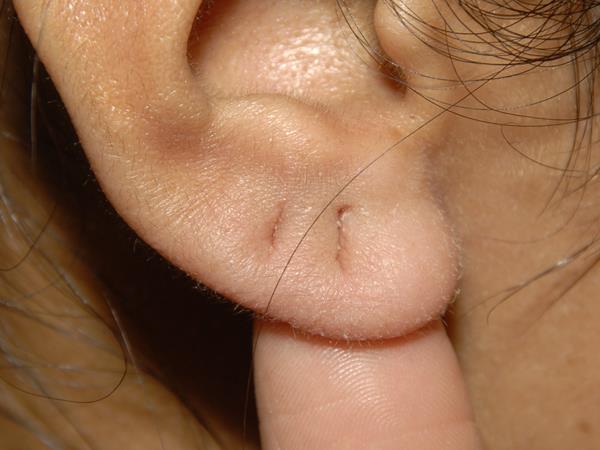

Split Earlobe repair